Repository navigation
Print configuration on scheduler startup. - #22588
Conversation


|
Couple things: I think we should only show non-default config (I'm not sure if this is already the case, but I don't think it is) and should we do this for other components also? |

I fully agree we should have it for all components. However I think showing complete config is a bit better. Ideally it should also show where the config came from =- default, config file, variable, secret. And this might need a bit modification of the conf code. But I tink it is crucial part of this change - knowing where each configuration variable came from would make it infintely easier to diagnose problems of people who - for example - have systemd and do not realize their Not seeing the config values currently is the major source of problems (I've seen multiple issues about it) for people who do not realize that Such misconfigurations are next to impossible to diagnose currently, they rely mostly on guessing. Note that gunicorn makes it a bit difficult for webserver because it will print logs every time gunicorn restarts the process which makes it rather annoying - so this information shoudl only be printed in the main process of webserver. |
|
Another option is to "query" or send signal to runing webserver/scheduler/triggerer (traditionally SIGUSR1 is used for similar feature) to know what configuration it sees, but I think dumping it to the logs at startup is far easier for diagnostic purposes (if it is written only once at startup). |
|
Also showing the source makes perfect sense to me, so +1 on that. I still think we should only show the non-defaults, however. Way less noise, and makes my typical first question of "what config have you changed" much easier to answer 🤷♂️. Maybe we send the non-defaults to logs, and let SIGURS1 dump it all? Best of both worlds? |
Yeah. less noise for sure. And yeah. You are right it shows "changes" - I like it more :). SIGUSR1 woudl be a bonus I think ;) |

|
Thanks @jedcunningham and @potiuk for the feedback. I have modified the PR so that non-default configuration is displayed along with source in [] as below indicating whether it's from environment variable / airflow.cfg / cmd. For signal SIGUSR1 in non-daemon mode I have added a handler that prints all configuration including default. I have added tests to ensure "default" is filtered by default :) I have used print since $ airflow scheduler
____________ _____________
____ |__( )_________ __/__ /________ __
____ /| |_ /__ ___/_ /_ __ /_ __ \_ | /| / /
___ ___ | / _ / _ __/ _ / / /_/ /_ |/ |/ /
_/_/ |_/_/ /_/ /_/ /_/ \____/____/|__/
[core]
dags_folder = < hidden > [env var]
hostname_callable = socket.getfqdn [airflow.cfg]
default_timezone = utc [airflow.cfg]
executor = < hidden > [env var]
sql_alchemy_conn = < hidden > [env var]
sql_engine_encoding = utf-8 [airflow.cfg]
sql_alchemy_pool_enabled = True [airflow.cfg] |
|
Oh wow. That looks cool. I think adding syntax highliting/rich colors would be fantastic in the print() but then also logging it to the log (without syntax) migh tbe useful. The first one wiell be great for casual users for testing and seeing that their specifc values are used, the second would be for diagnosticts (sometimes stuiff printed on stdout might be silently swallowed. |

|
NICE! @jedcunningham - WDYT? I think this one is cool. |
|
I'd say that one qualifies as PR of the month ;) (pity the newsletter is out). |

There was a problem hiding this comment.
Hmm, why is parallelism hidden 🤔
There was a problem hiding this comment.
I have display_sensitive=False (default value is False) which hides all values from env, vars and command. I don't want to pass display_sensitive=True since that might dump sensitive values to logs in case of starting as daemon or systemd. I guess we can try filtering for sensitive values in the for loop similar to how "default" values are filtered out so that other values from env/cmd are shown. Thoughts?
airflow/airflow/configuration.py
Lines 717 to 719 in dc75f5d
There was a problem hiding this comment.
That was what I was fearing it might be. I guess let's not worry about it now for now. This does make this less comprehensive than I was initially imaging as it's not uncommon to use env vars for non-sensitive config as well.
There was a problem hiding this comment.
Ough. I did not know display_sensitive is "so sensitive" :) .
I thin what we could do though is to implement a new flag in the dict less_sensitive_config :) (?) and do few things there:
- hide anything coming from secret (I think there is flag that just shows path rather than value for that already and it is on by default)
- We already have the list of sensitive configs - we could hide them by default:
    sensitive_config_values = {
        ('core', 'sql_alchemy_conn'),
        ('core', 'fernet_key'),
        ('celery', 'broker_url'),
        ('celery', 'flower_basic_auth'),
        ('celery', 'result_backend'),
        ('atlas', 'password'),
        ('smtp', 'smtp_password'),
        ('webserver', 'secret_key'),
    }
- we can pass config through "redact()" - and we could extend the semantics of
sensitive_var_conn_namesto also cover key names of sensitive data (or we could even add another configsensitive_configuration_nameswhere user could specify which of the config they want to hide).
There was a problem hiding this comment.
Thanks @potiuk , I would like to have this as a separate issue since it might need more discussion on what and how to filter out items.
There was a problem hiding this comment.
Thanks @potiuk , I would like to have this as a separate issue since it might need more discussion on what and how to filter out items.
Sure. Works for me :)
|
One more last comment since there is also static check to fix (I promise it's the last one :). It would be great to write a paragraph or two about this behaviour (including the SIGUSR1 option) in https://airflow.apache.org/docs/apache-airflow/stable/howto/set-config.html . This is so tht we do not need to explain it to the users, but just send them the link. |

|
Thanks @jedcunningham I have fixed comments except for the value for env, cmd. Thanks @potiuk, there is a note in the docs about configuration being different across webserver and worker can cause issue. I have added a note there since I felt it's appropriate. Feel free to suggest other wording if it can be explained better.
|
 potiuk
left a comment
potiuk
left a comment
There was a problem hiding this comment.
Looks great. I think we should also add it for other components (separate PR). I think we should also encourage users to use the same configuation everywhere even if it s not technically needed - simply because it makes diagnostics and investigations better. Having the same output in all components might help with that.
 github-actions
Bot
added
the
full tests needed

|
The PR most likely needs to run full matrix of tests because it modifies parts of the core of Airflow. However, committers might decide to merge it quickly and take the risk. If they don't merge it quickly - please rebase it to the latest main at your convenience, or amend the last commit of the PR, and push it with --force-with-lease. |
f586895 to
46d21cf
Compare


…efault configuration on SIGUSR1.

Co-authored-by: Jed Cunningham <66968678+jedcunningham@users.noreply.github.com>
92e4b4f to
19ef2c8
Compare

|
Thanks @potiuk and @jedcunningham for the feedback :) |

|
This PR needs fixing -- the current behaviour is a) noisy and b) useless when using env vars to configure things. Those dag_folder and executor should be shown. Coming form an env var does not mean it should be hidden. Please fix this today or else I'll have to revert it before the release. Secondly it should be possible to turn this off (I'd possibly even argue it should be off by default) Thirdly there should be some message about "running config" -- when I first saw this happen I thought someone had left in a debug print somewhere in the code! |
This should not happen for task commands -- it would show up in task logs (twice, for Reasons) and make viewing the actual task logs harder. |
|
Having this config display as a |
We already have |
|
I was thinking specifically "here is the non-default config you are running with" which |
Right. Yeah. |

|
+1 for having it in |
|
I am fine with the reversion if this needs more time to discuss on the what and how things should be displayed along with the appropriate subcommand it should come under. |

This reverts commit 78586b4.
 ephraimbuddy
added
the
changelog:skip
|
I think it's worth to revive it @tirkarthi
Hey @kaxil - I think you do not fully grasp the problem we are trying to solve. Both should be there - logs and CLI. As stated elsewhere CLI might give DIFFERENT results than what airflow sees, especially when you use systemd. Many people (even those who are tasked with installing Airlfow) are not aware that setting configuration and variables in And if you do it for "airflow" user, ti all looks COOL. And we only find out because the user sends us a stacktrace that indicates that sqlite database has not been initialized (and we only know that this is sqlite because you see deep in the stactrace that sqlite driver is used). And those users claim that "no we are not using sqlite - we are using Postgres - look, this is output of my Those are true stories which I experienced (and mutliple times). The only way to check what REALLLY airlfow sees is to print it in the logs together with the source where they came from. There is no other certain way. |
|
So if we have this feature - we will just ask the user "send us the first lines of the log containing the configuration" when in doubt. |
@tirkarthi - can you please re-start working on this feature :) ? I think this is the best way to conclude the discussion. |
|
@tirkarthi (also @ashb and @kaxil and @jedcunningham ) - here is an exact example of why I think displaying configuration with source of it in the logs makes perfect sense and we need it:
If we printed the source of configuration in the logs, at step 5) we could ask for it or possibly user would have noticed it on their own and never opened an issue. |
Doesn't the UI already show that information if you go to Admin -> Config? |
|
@potiuk I had similar thoughts reading the issue that there should be some configuration difference between using the cli to print configuration and the actual scheduler process. I guess we can have the configuration part to be dumped only when we send a signal sent to scheduler process since there is no consensus on cli option to print or printing by default during startup etc. |
Webserver could (I am not sure if it shows source of variable -likely yes) . But not for scheduler. The example here was with Webserver but this issue would have been exactly the same if the variable was set for scheduler's systemd. (and that's what this PR was about :). |
The signal is nice, but I think many people do not even know how to send a signal to their process when it runs on a remote system or they might not have enough permissions to do so, but they can see the logs: https://man7.org/linux/man-pages/man2/kill.2.html
|
Also one more comment for that -> I recalled that config is disabled by default for security in most installations. So even for webserver, the only place you can see the "effective" configuration of webserver are logs. |
|
We can still have a flag on the |
The problem is that those who need it (and come to use with issues), have usually no good idea nor control on how to change their systemd or similar configuration. Asking those people to modify their deployment configuration to add their options when they have really vague idea how their airflow is started in teh first place is pretty counter-productive. The idea is to get good answers on what configuration is used - without them having to understand that first. I think (as long as we do it once at startup) - there is literally 0 overhead to print configuration (especially the non-default one) to the logs. We are really talking about the case where: a) there is an "admin" of airflow who vaguely knows how their system is configured (happens when you have a new person which is tasked with Airflow maintenance) b) that persons sees a strange behaviour and is not able to diagnose it so it runs cli to send and it shows some configuration which is reported to us ("yes I have it configured this way"). I simply want to have a way to tell the user "are you 100% sure this is what your webserver does" - can you open your logs and show the "startup" logs of the webserver? In many cases showing the logs will be far easier to ask the user for rather than "check whatever configuration your deployment starts airflow with" - because then we might not get authoritative answer, we might guess ourselves and the admin might guess it too without knowing exactly the systemd configuration. Been there, done that many times. Yeah. Those poople should know better. But by seing the configuration we can actually tell them that because we will see what they think about their configuration is wrong - before that we can just guess it, and we might guess wrongly. |
|
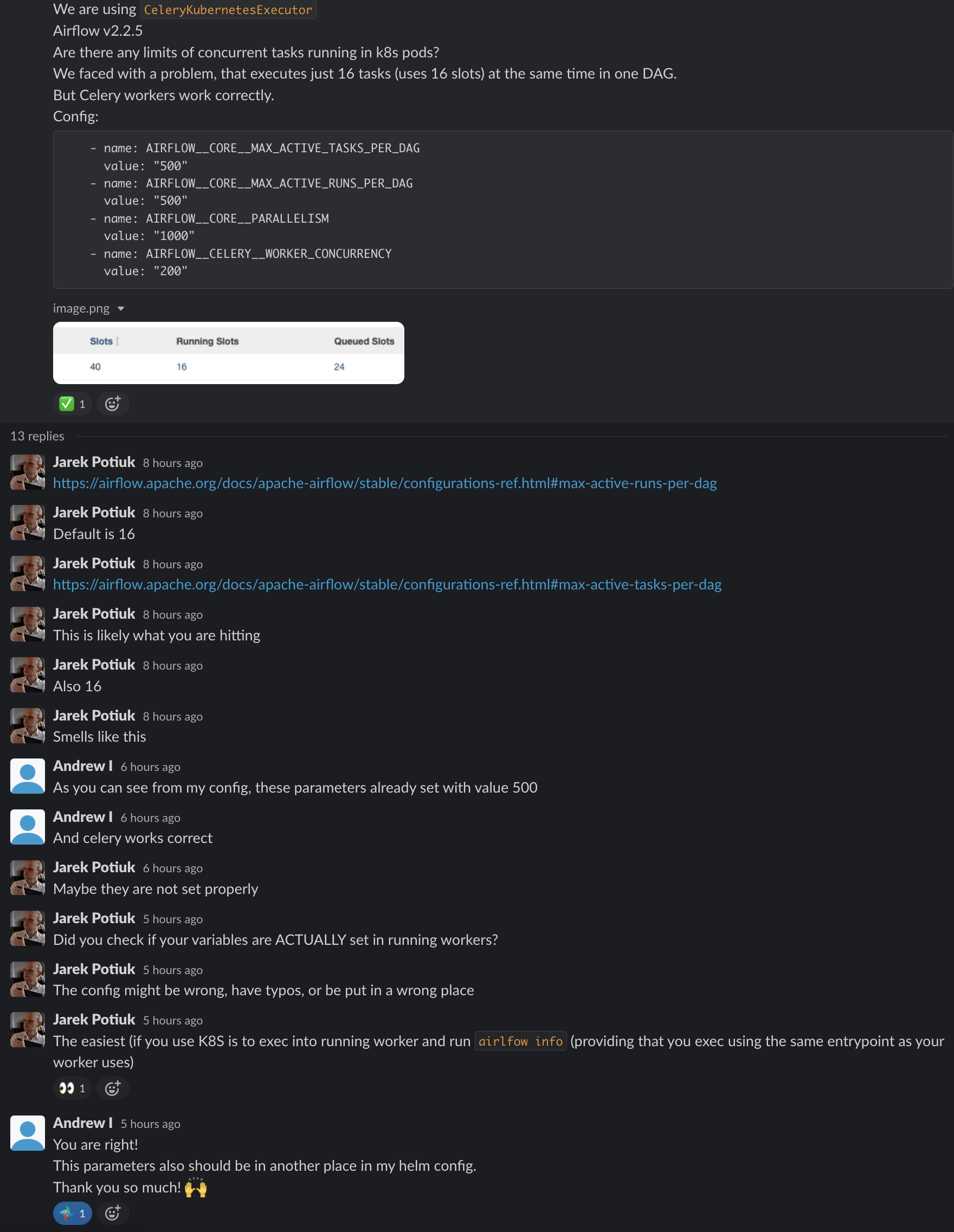
Just as further "real life" example (yes I know I am pretty stubborn and persisten) From https://apache-airflow.slack.com/archives/CCQ7EGB1P/p1654267866780949 I literally wildely guessed that the user has wrongly set their config. They did not even use systemd but their own helm chart. And despite all the evidence (config variables were OK) I based my assumptions on "16" being default value for the "max_tasks_per_dagrun" value that the configuration is wrongly applied.
This was a wild guess and a leap of faith. If we print configuration in Airflow logs, I would not have to guess and make very bold statements, I would just have to ask the user to send me the logs. The "You are right! Thank you" is a bitter-sweet for me. On one hand feels good I could help our user on the other I feel bad that I know we have no good way to diagnose similar issues and we will have to revert to "leap of faith" rather than real data multiple times in the future when others will have similar problems. If that does not convince you @kaxil @ash then I am a bit lost why we are opposing it. This is extremely low effort, extremely low overhead and yet (by opposing it) we managed to make somoene who wanted to contribute it to abandon the idea as they saw "no consensus". |


This PR prints the configuration used during scheduler startup. The sensitive values are masked so that they are not captured by mistake in log files.
closes: #22141
related: #22141