

Ampel is a lightweight supply chain policy engine designed to be embedded across the software development lifecycle to make sure that source code, tools and the build environment can be trusted by verifying unforgeable metadata captured in signed attestations.
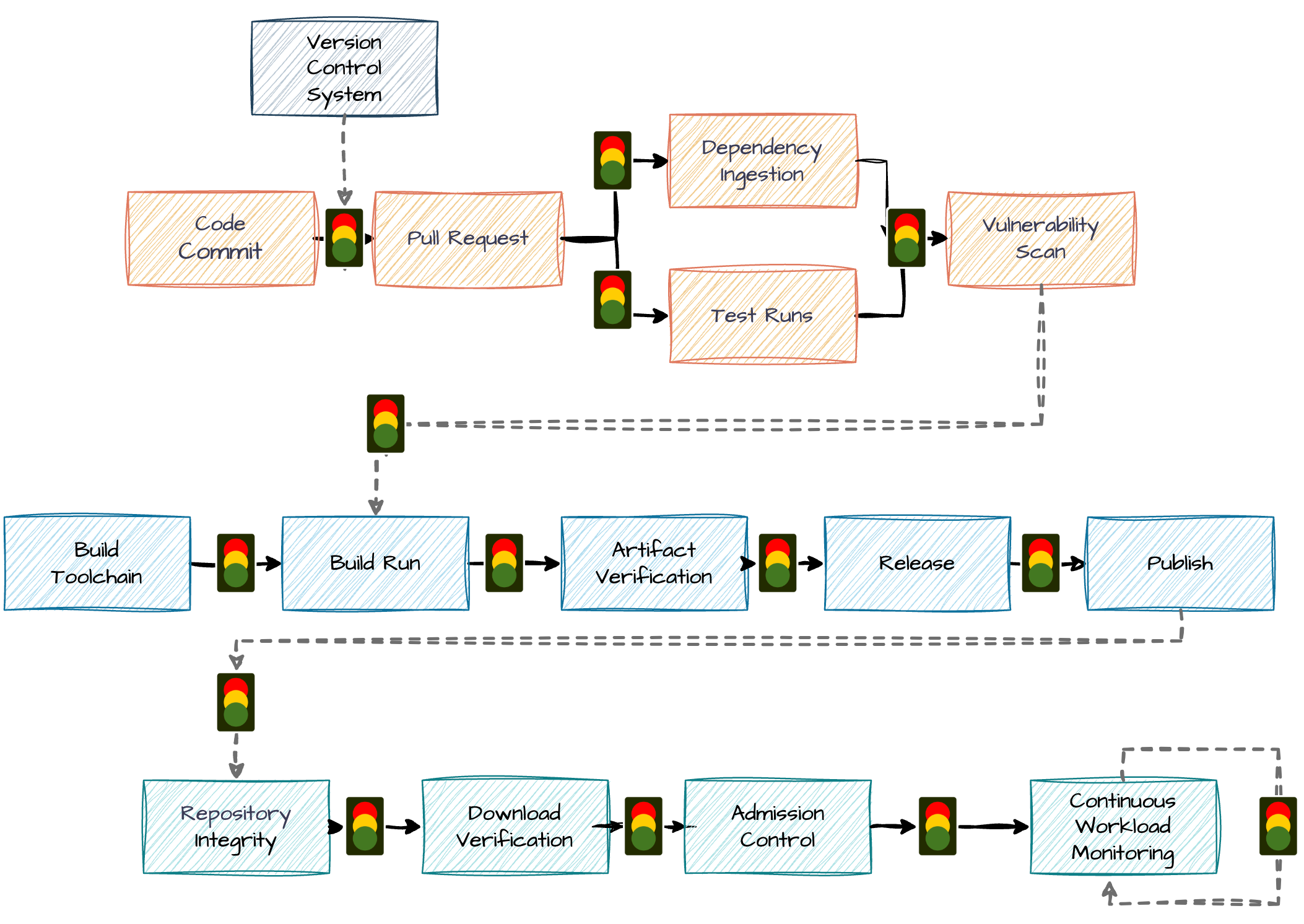
Ampel works with attestations in the in-toto format and has native verification support for sigstore bundles. Signing schemes are pluggable, meaning other signature verification mechanisms can be added.
As a supply chain security tool, Ampel can work with common formats like SLSA to check software provenance and SBOMs to gate on dependency data, but policies can be written against any custom data in JSON.
The policy engine also supports transformers that can read and verify attestations to then convert them to other formats, simplifying policy authoring. For example, by loading the vulnerability report transformer, Ampel can transform the output of the common vulnerability scanners to a common format, such as OSV, allowing you to write a single policy to verify the findings of any scanner.
Pre-built binaries for Linux, macOS and Windows are available on the
GitHub Releases page.
Download the binary for your architecture, and place it as
ampel binary somewhere in your $PATH.
Ampel is available through the Carabiner Homebrew tap:
brew install carabiner-dev/tap/ampelOr, if you prefer to tap explicitly:
brew tap carabiner-dev/tap
brew install ampelIf you have Go installed, you can install ampel directly:
go install github.com/policylabs/ampel/cmd/ampel@latestEvery release also publishes a container image, signed with sigstore and with
its SLSA provenance attached (the quick start below verifies it). The image
runs ampel as its entrypoint, so mount the policy and evidence you need:
docker run --rm -v "$PWD:/work" -w /work ghcr.io/policylabs/ampel:v1.4.2 \
  verify sha256:e3b0c44298fc1c149afbf4c8996fb92427ae41e4649b934ca495991b7852b855 \
  -p docs/examples/sbom/sbom-checks.hjson \
-a docs/examples/sbom/sbom.spdx.intoto.jsonAmpel is also available as a GitHub Action for use in CI/CD workflows. See carabiner-dev/actions for setup instructions and usage examples.
An evaluation needs three things: a subject to verify, a policy, and
attestations about the subject. The docs/examples directory
holds small policies with the attestations they read, so every command below
runs from a checkout of this repository with no network access and nothing
else to set up.
The examples describe an imaginary artifact, so the subject is given as its digest. This one checks the artifact's SBOM: every package declares a license, the licenses are on an allowed list, and a required dependency is present.
ampel verify sha256:e3b0c44298fc1c149afbf4c8996fb92427ae41e4649b934ca495991b7852b855 \
  -p docs/examples/sbom/sbom-checks.hjson \
  -a docs/examples/sbom/sbom.spdx.intoto.json
With a real file, pass its path instead of the digest and ampel hashes it:
ampel verify ./dist/app-linux-amd64 -p policy.hjson -a provenance.intoto.jsonampel verify is short for ampel verify artifact. Attestations given with
-a are admitted even when unsigned, which is fine for a demo; in production
you let collectors fetch signed attestations (-c) and name the trusted
signers in the policy.
ampel verify image resolves an image reference to the digest of its
manifest, the digest signatures and attestations about an image are bound to,
and collects the attestations attached to the image in its registry (under
cosign's .att tag or as OCI referrers) without further configuration. The
ampel release signs its own image and attaches SLSA provenance to it, so this
checks a real image: the provenance must be signed by the release workflow,
and must say the image was built by that workflow, on GitHub Actions, from
this repository.
ampel verify image ghcr.io/policylabs/ampel:v1.4.2 \
  -p docs/examples/image/ampel-image.hjson
To try the command without a registry, use a digest reference, which needs no lookup, turn the registry collectors off and read the example attestation from a file:
ampel verify image ghcr.io/example/hello-world@sha256:e3b0c44298fc1c149afbf4c8996fb92427ae41e4649b934ca495991b7852b855 \
  --registry-attestations=false \
  -p docs/examples/custom-predicate/code-review.hjson \
  -a docs/examples/custom-predicate/code-review.intoto.json
For a multi-platform image, --platform linux/arm64 verifies one platform's
manifest instead of the index, for attestations that name the platform
manifests rather than the index.
ampel verify model hashes a model directory the way the
OpenSSF Model Signing
specification defines, so attestations produced by model signing match it.
The example model is the two-file model of the specification's conformance
suite, with the statement its signature carries:
ampel verify model docs/examples/model/simple \
  -p docs/examples/model/model-signing.hjson \
  -a docs/examples/model/model-signing.intoto.json
The examples guide walks through each example, and the documentation covers policies, attestations, collectors and results in depth.
Policy evaluation relies on attestations. AMPEL relies on the Policy Labs collector to read attestations from all sorts of backends, from repositories, registries, filesystems and more.
Ampel is part of a growing ecosystem of tools that let software developers and security engineers harden their SDLC processes. The more mature siblings of AMPEL are:
-
bnd: A tool to attest, sign and verify data. It also has features that work with attestations and sigstore bundles.
-
snappy: Takes snapshots of APIs to attest their state.
-
unpack: A dependency extractor with SBOM visualization and generation capabilities.
-
oms: Signs and verifies AI models following the OpenSSF Model Signing specification. Its hashing is what
ampel verify modeluses.
Ampel uses a model of policies as code. The policy frame can be written in either JSON or HJSON format (HJSON is recommended for better readability with support for comments and relaxed syntax). The evaluation code is written in a supported runtime. At present Ampel ships with a CEL (Common Expression Language) runtime and more runtimes are in the roadmap.
The structure of an Ampel policy is described at length in its own documentation At a higher level a policy consists of:
- Metadata
- Contextual Info
- Attestation Spec
- Identity Definition
- Tenets (one or more)
A policy's tenets (those principles we hold to be true) are the core of the policy. Each tenet represents a check Ampel will perform on the available evidence.
The tenet structure contains the evaluation code that will be executed to check if the tenet holds true.
A policy's tenets can be evaluated in two modes:
ANDa policy will evaluate to PASS when all tenets are true.ORa policy willPASSif at least one tenet evaluates to true. Useful when there is more than one way to check.
Think of tenets as questions to ask your attested data:
- Was this artifact built by my GitHub account?
- Does my vulnerability report contain HIGH CVEs?
- Does this repository have MFA enabled?
- Is this project licensed under an approved OSI license?
- ... and more.
A policy can be linked to a security framework control. When evaluating the compliance status of artifacts against a security framework, Ampel can link the policies to controls and checks defined in OSCAL catalogs and profiles.
Ampel can report the status of a policy or block processes when a policy evaluates
to FAIL. But the evaluation results are rich with metadata and human-friendly
messages which makes them suitable to display in various situations such as reports,
webpages, CI/CD systems, etc.
A powerful feature of Ampel is that evaluation results can also be attested. This means that results can be used as input attestations for further policies, making it simple to check for complex processes further downstream after they have been checked once.
Result attestations can be produced as the full Ampel ResultSet, as a SLSA
Verification Summary Attestation (VSA)
or as an in-toto Simple Verification Result (SVR),
and can optionally be signed with sigstore, SPIFFE, or a local key via the
--sign flag. See Producing Result Attestations
for details.
Multiple policies can be specified together in a PolicySet. This is a handy way
to maintain policies that relate to each other in a single file to make them
available to the engine at evaluation time. The results of policies tied together
in a PolicySet can also be reported together in a ResultsSet. When there is more
than one way to satisfy a requirement, a PolicyGroup holds blocks of
alternative policies; see the policy groups guide.
Ampel is released under the Apache 2.0 license by The Policy Labs Project Contributors. Feel free to contribute patches or open an issue if you find a problem. Feedback is always welcome!