
This repository contains examples that demonstrate specific usage of the Distributional Analytics Platform, DBNL. For more information on usage of the product see https://docs.dbnl.com.
All of these examples can be previewed in our read-only SaaS environment.
These examples rely on a local Sandbox deployment of DBNL, which requires:
- Docker
dbnl- (pip install dbnl)- 8GB of free RAM
- 5GB of free storage
All DBNL projects require a Model Connection to an LLM. For these examples we recommend GPT-OSS-20B or similar.
The fastest way to install a local deployment of the DBNL Sandbox and push data to your first project.
- quickstart: This example replicates the local sandbox example for spinning up a local instance of DBNL and uploading data via the Python SDK from the Quickstart in the docs: https://docs.dbnl.com/get-started/quickstart
Various examples on how to format and get data into your DBNL deployment. For first time users, we recommend adk_calculator_sdk_from_otel because it gives you the most control, visibility, and flexibility for the least ammount of work. For long term usage we recommend adk_calculator_otel_direct because it requires the fewest external processes and storage. If you already have a mature ETL pipeline without OTEL, but have the ability to construct span data then check out adk_calculator_sdk_from_json to see how to manually construct JSON and a pandas dataframe that fits the DBNL Semantic Convention.
- adk_calculator_sdk_from_json: This example shows how to instrument the collection of data required by the DBNL Semantic Convention automatically from a simple calculator agent using the Google ADK into JSON format, which can then be easily augmented and uploaded to DBNL via the Python SDK.
- adk_calculator_sdk_from_otel: This example shows how to instrument the collection of data required by the DBNL Semantic Convention automatically from a simple calculator agent using the Google ADK through a local OTEL collector writing raw spans to file in the Open Inference semantic convention, which can then be easily augmented and uploaded to DBNL via the Python SDK. DBNL will automatically flatten traces in this format contained in the
traces_datacolumn in a pandas dataframe upon upload. - adk_calculator_otel_direct: This example shows how to instrument a simple calculator agent using the Google ADK to send OTEL traces directly to your DBNL deployment using the built in trace collector.
- sdk_from_langfuse_export: This examples shows how to transform langfuse exported traces and observation jsonl files into the DBNL Semantic Convention, augment the resulting dataframe, and upload it to DBNL.
These tutorials show completely reproduceable, end-to-end examples of using DBNL for various tasks, from simple analytics to AB testing and hyperparameter optimization.
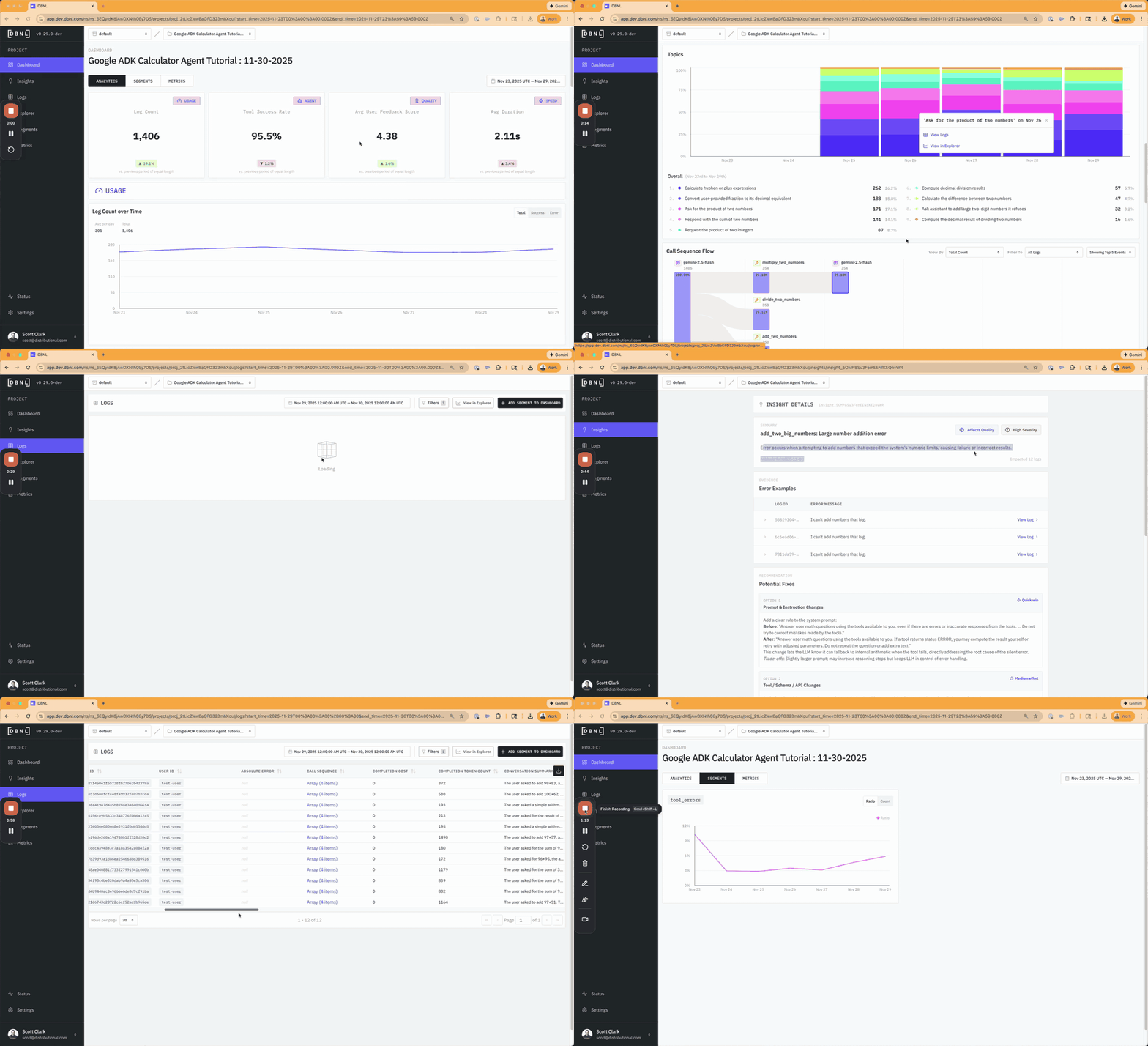
- adk_calculator_tutorial: This examples simulated two full weeks of data of the calculator agent above with the full DBNL Semantic Convention.
- ab_test_example: This example shows how DBNL behavioral analytics can help discover issues and resolve them through AB testing agents.
- nemo_agent_toolkit_hpo_example: This example demonstrates using NVIDIA's NeMo Agent Toolkit (NAT) for hyperparameter optimization (HPO) on a calculator agent, with DBNL providing behavioral analytics to discover issues in production.
For more inspiration, check out the walkthroughs in our docs for more detailed and realistic examples on production agents.